From Cathleen – A Serious Look at Humor
As we at Touchstone don our Christmas onesies, learn Busby Berkeley-esque choreography with shopping carts, and put finishing touches on re-written early 80s rock ballads, I’ve been thinking very seriously about the subject of “humor.”
It seems I am not alone. I recently stumbled across this fun and illuminating short essay by The New Yorker’s Bob Mankoff, which traces the etymology of “humor” from to its Latin root (humorem, meaning fluid) to medical practices of the ancient Greeks. From Hippocrates to Roman and Islamic physicians, “Humoral medicine” predominated medical thought until the advent of modern medicine in the 19th century (leeches, anyone?) and held that the four “humors” of the body–phlegm, blood, yellow and black bile–were responsible for a person’s health. Mankoff goes on to reveal:

“Humoral medicine eventually morphed into humoral psychology. Having your humors out of whack could make you dull, tetchy, overly hopeful, or a sourpuss.”
Dully, tetchy, overly hopeful, a sourpuss….sounds like an interesting bunch, at least from a theatrical perspective. Oh, wait…
“These characterological deviants were called “humorists,” and the people who mocked them were called “men of humor.” I know, I know, it should be the other way around, and in due time it was.”
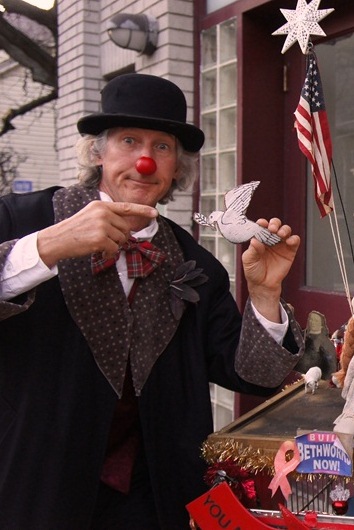
The Old Guy, a hobo-politico of the yellow bile variety
Might I introduce some the cast of this year’s Christmas City Follies XII? Consider Bill George’s Old Guy (yellow bile), a cantankerous hobo-politico, with a fiery tongue to match his squeaky cart. The good-natured sanguine type (blood)– in both color and disposition– is clearly Follies’ beloved silent clown, Little Red. The melancholic of this year’s show may be Teresa, a cubicle-dwelling office cog moping out of the office party to wax nostalgic on childhood fancy, or perhaps even…Panda? We’ll see if he’s gotten out of his funk from last year’s Christmas Eve break up.

Teresa, an office-working melancholic
Along with his playful illustrations, Mankoff fills in the gap to the word’s modern-day usage:
“In the interim, the idea caught on that by throwing odd characters together on the stage, or in a book, you would have the ingredients of comic conflict. Conflict between different personality types is unpleasant in personal life but funny when exaggerated for comic effect.”
Every year, Christmas City Follies is truly a mixed bag, combining both verbal and non-verbal sketches, dance, live music and, at times, poignant reflections on the holiday season. Yet, it is in returning beloved characters year after year that cause Lehigh Valley children to grow into adults who, in turn, return as audience members with their own families. The ancient Greeks once sought to understand the complexity of human “personality” as a function of physical processes; we as actors create larger-than-life characters in an attempt to capture the essence of human “types” that make the world an interesting place, and through which we recognize the “out of whack”, oft-hidden, unsavory parts of ourselves… the sour, the gullible, the grumpy, mope… and laugh.
From Lisa – Behind the Scenes of ArtsTouch

Students in the BUILDING BRIDGES program learn about creative expression through work with masks.
One of my favorite parts of being a Touchstone Ensemble Member is teaching “Building Bridges”, one of our signature ArtsTouch programs.
Okay, background first! Touchstone and the Colonial Academy Intermediate Unit (IU) developed this program roughly ten years ago. It is intended for students struggling in mainstream classes and subsequently placed in partial or emotional support classrooms for any number of reasons – abuse, neglect, mental health issues, drugs, etc. I have been a teaching artist with the “Building Bridges” program for the last four years.
This week, I’ve been energized to meet and get to know the “Bridges” Fall 2011 class. With the group, comprised of high school and middle school students, teachers, teacher aides, an IU representative, and us, the Touchstone teaching artists, we start and end each session with Circle Check-in:
- Your name
- One word to describe how you’re feeling
- A movement and sound to match
Followed by the group “playing it back” – first listening to the individual, then repeating together. For example:
- Lisa
- Mischievous
- Tapping hands together with a slightly evil laugh
Anything goes within these guidelines – the sound and movement can be representational or abstract – however each person wants to communicate what they are feeling at that moment. Afterwards, we all understand what “baggage” (good or bad) everyone is bringing to the session. It’s always fun to see the change that occurs between Check-in and Check-out – tired to energized, bored to interested, unsure to curious, etc. There’s usually someone who ends with “hungry” since they go right from the session to lunch!
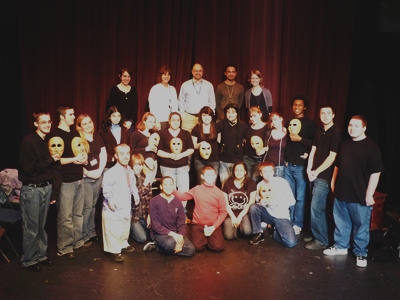
The BUILDING BRIDGES class of Fall 2010
In each session, there is a variety of games and exercises to build both theatre and life skills. It’s not difficult to sneak in confidence-building and communication skills when doing theatre exercises. For example, with improv games, a key skill is being a present partner – ready and open to ideas, listening and able to respond clearly and confidently – excellent skills to have on a job interview, or communicating with friends and family.
The change witnessed over the course of the residency is amazing. For some it can be slight – a deeper interest in the arts, perhaps, or better attendance at school. Others are transformed into more confident, expressive versions of themselves. There’s a whole team of people from teachers to family members to social workers helping these students get on the right track. As a Touchstone teaching artist, I feel extremely fortunate to be able to interact and play a part in the moving each young person towards a healthier, more successful path.
From Jp – Follies 101
Follies has begun, and we are about a third of the way through our process. I wanted to give everyone a crash course on what that process is.

The cast and crew of Christmas City Follies XII gathers for a day of brainstorming
Day one, the cast and production team enter the rehearsal room and begin writing down every idea we have for this year’s show. This year, it took us over three hours to get all the ideas out, and we had somewhere near 75 ideas written on sticky notes by the end. All these sticky notes get put up on a wall as a constant reminder of our starting point. By the end of the process, a lot of these sticky notes will be stuck to one another, creating idea clusters.
From all these ideas, we whittle down to about 20 that will actually make it into the show. For the first third of the rehearsal process, we allow new ideas to be added to the wall, but after this point, new notes are done with (unless of course they are too amazing to not put up).
Our next phase is seeing what works. We get all the ideas that have successfully proven themselves from phase one on their feet to see what they look like and, more importantly, to see if there is some type of continuity to tie the show together. Often times coming out of phase two, we will be leaving amazing pieces behind, because we just can’t seem to fit them in with the other pieces.

The final product: a special treat for the holiday season.
I often think about directing Follies as producing an album. You’re given two sides to the album (in our case, a two act structure) – each one of these sides has to work and flow by themselves while serving the overall album concept from start to finish. What I strive to avoid is encountering a feeling of “this song doesn’t work, on this album”.
Once these programmatic decisions are made, we move into the fine tuning and final phase before heading into tech and show. We have a bunch of pieces that are halfway done and a clear vision of what the show is supposed to look like, and we begin rehearsing it. Sometimes during this third phase, we will find that “one of the songs, doesn’t fit”; and even at this late stage, we’ll possibly be making cuts. But at the same time, we may find gaps and need to create a new scene to bridge something together or to add more of a “feeling” that may be lacking.
Now in my seventh year serving in some type of directorial capacity on this show, I think I have a grasp for it, and generally this process is fairly painless. As director, the most painful part of the process is opening night when I push the ship into the water and slowly loosen my grip. Directing Follies is one of my favorite duties, with its biggest pay off being something I’ve heard every year from a passing audience member: “This is the best one yet.”
From Bill – Life of the Artist (part the first)
It’s kind of a loaded word, “artist”. Look it up in the dictionary and it says a bunch of things, but the one that is on my mind right now is this:
art•ist [ahr-tist] noun
1. a person who produces works in any of the arts that are primarily subject to aesthetic criteria.
We just finished a run of Into the Dark, the culmination of eight months’ work, and there were any number of “criteria” that the work was subject to that weren’t aesthetic – time and money, of course, but also personnel, skills available, the balance of the ensemble as a creative team, audiences’ interests, presentation, being understandable, and reaching our target audience – all these forces and many more weigh and influence the work. Art is not free to be concerned with aesthetic criteria alone, that’s for certain. And primarily? I’m not so sure; and what is “the right mix”?
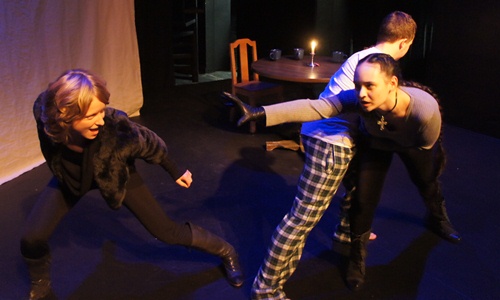
Cathleen, Rob, and Emma in "The Hound of God," a scene from INTO THE DARK - reaching out toward something that always seems to get away.
Back to the dictionary:
art [ahrt] noun
1. the quality, production, expression, or realm, according to aesthetic principles, of what is beautiful, appealing, or of more than ordinary significance.
So, lifting us out of the ordinary is key, but what if your aesthetic goal is to show and strengthen the beauty that is inherent in us all? It’s common, but extraordinary nevertheless. There’s a conundrum here, or at least there is for me. If you think about it, there isn’t a moment that goes by that isn’t filled with art, beauty. Do the geese flying overhead intend to be beautiful? Is the silver water of the pond reflecting their passage asked if it chooses to do so? It is there for all to see if we will simply lift our eyes.
The job of the artist, then, for me, isn’t so much about creating art, as it is assisting our audiences to lift their eyes. For some reason, that makes sense to me, makes things clearer.
From Emma – Appreciating Now
Tonight, we go into our second weekend of Into the Dark.
But in the four days since our last show, it’s been a week of looking ahead. We had a field trip for the Civil War Project. We have a poster and postcard design finalized for this year’s Christmas City Follies. We had our first rehearsal for Follies. We’re in communication about our fabulous guest artist Sean Lewis for Killadelphia. And the apprentices are already having a preliminary meeting for Fresh Voices, which doesn’t open until February!
It’s absolutely vital for us to constantly be looking forward in this work, which always takes more time than expected, but it’s also work where we constantly have to remind ourselves to pause and remember where we are.
That’s one of the big challenges – and blessings – about putting on a show. It’s like we’re putting the rest of the world on hold for a couple hour, putting aside the things that we know have gone before or the things that we worry are coming, and we’re just present, together. Onstage or offstage, actors or technicians, the show doesn’t go forward if we can’t all be an ensemble, functioning in the “now”.
There’s a lot to get through today. But in a few hours, it’ll be time to put everything else on pause and just live in this world we’ve created in the show. Just us – cast, crew, and audience – all of us together, sharing the space, for an hour and a half. It’s a good feeling.
Welcome Back Stage with the Touchstone Ensemble
Welcome to Touchstone Backstage! Touchstone Theatre is an ensemble theatre company based in Bethlehem, PA, dedicated to being an active force in the renewal of theatre as a vital art form. We love collaboration; we’re always excited to share our thoughts on the process and open up our creative circle, and to that end, we’ve created a blog to chronicle our work and hear from you.
One of the most important things to us as a company is the idea of an Ensemble, created of many voices. In the spirit of ensemble, we’ll all be taking turns at updating this blog, detailing the plays and projects we’re working on now, exciting advancements in our areas of expertise, and what it means to each of us to be members of Touchstone and the greater theatrical community.
So, join us backstage. Come play with us. We can’t wait to show you around!

 Touchstone Backstage