From Lisa – A House Manager with No House

Lisa examines her front-of-house options at Moravian College, one of the venues for A RESTING PLACE.
Last Wednesday, part of the The Civil War/Cemetery Project production team – Jp (Production Manager), Emma (Stage Manager) and myself (House Manager) – went on a field trip to visit each of the performance venues for A Resting Place. This visit happened to be on one of the few days this winter that actually felt like winter – rainy, windy, and cold! Nevertheless, it was an incredibly exciting and daunting trip…
But first a bit of background:
The Civil War/Cemetery Project features five performances of A Resting Place, an original play based on the lives of Bethlehemites who lived during the time of the Civil War. During the story gathering research phase, we discovered that Dan Rice, a real life traveling performer of the times, visited Bethlehem in October of 1863. After this breakthrough, we chose to place Rice in the role of narrator or “magician” brought to Bethlehem to conjure up these local histories. Once Rice became a key element, our goal was to create a traveling performance with a circus feel which required moving the production outside, building a circus wagon that can travel to each location, and filling the cast with jugglers, contortionists, and a life-sized elephant puppet that will lead the circus wagon into each venue!
And now back to the exciting versus daunting.
EXCITING because the venues are amazing – on both the North and South sides of Bethlehem at five distinct locations: 1) Moravian College campus on the patio of the Priscilla Payne Hurd Academic Complex, 2) South Bethlehem Greenway right behind Touchstone, 3) Lehigh University campus on the lawn by Packer Chapel, 4) City Hall Plaza right next to the library, and 5) Historic Bethlehem Partnership’s Industrial Colonial Quarter on the hill below Hotel Bethlehem. Though we love our intimate 75-seat theatre, at outside venues we can reach triple (if not quadruple!) the number of audience members at each performance.

Bethlehem's Historic Colonial-Industrial Quarter - another venue.
DAUNTING because as House Manager I don’t have a nice neat theatre with a clear entrance, lobby, restrooms, and actual seats for people to sit in and watch the show. Nope, we have five completely different venues with five completely different needs. Plus, after four of the performances we transition right from performance venue to separate panel discussion or guest lecture venues. Cue panic music now…
So this week as the posters, postcards, and brochures are being placed around town, and rehearsals fill the evening and weekend hours here at Touchstone, my task begins of managing the venues. On the list that will shrink and grow as issues are resolved and new ones emerge are many questions, like: where can people park? where are the nearest restrooms? and just how many volunteers will I need at each venue? So far one major question is already answered: what happens if it rains? In that case we make the call 3 hours ahead, get the word out, and move the whole operation into the Ice House. One down, one hundred more to go.

The cast of A RESTING PLACE rehearses on the Greenway behind Touchstone, where they will perform in a little over a month.
As the April 13-15 weekend approaches and The Civil War/Cemetery Project becomes a reality, my hope is that all the preparations from every corner of the production served to make this new community-based offering the best experience possible for the audience. And with the team in place – Touchstone, Moravian College, 100+ community actors and musicians, countless community partners and volunteers – I know it will.
For a complete listing of events for the weekend of April 13-15, check out http://www.touchstone.org
From Jp – Inspiration, Near and Far
Creative inspiration can be found everywhere: right in your back yard, on the other side of the globe, or in the dark recesses of space (for the sake of this blog entry, we will stick to planet Earth and leave dark energy to the experts). Here are two things that have inspired me recently, one near, one far.
1. Two weekends ago was Touchstone’s annual apprentice showcase, Fresh Voices. It’s great to be in a position that allows me to watch young artists evolve. The first time we generally meet the apprentices are at their auditions the prior spring. This last season, we had the pleasure of working with the apprentices on both Into the Dark and Christmas City Follies before they began work on Fresh Voices. The challenge set before the apprentices for Fresh Voices is that they all must create their own solo performance, as well as a group piece. The outcomes of this challenge never cease to amaze me; we get to see young artists breathing life into their own creative voices and then coming together, we see those voices attempt to orchestrate themselves into a final composition. My congratulations to this year’s apprentices – well done! You all inspire me in your own ways.
2. Last May, myself and Ensemble Affiliate Christopher Shorr took a trip to Eastern Europe where we were able to do some research for a possible international theatre festival that Touchstone would host in 2014. Our first and favorite stop on this trip was Sibiu, Romania (that’s right, Transylvania!) for a ten day theatre festival. Here’s how their website describes the festival: “Sibiu International Theatre Festival is the most prominent annual performing arts event in Romania and the third in the world, in terms of audience (60,000/day), events (350), venues (60), and countries involved (70).” Being able to attend this festival was a serious game-changer for me; it both humbled and inspired. They recently released a video of highlights of last year’s festival. If I ever need a kick in the pants, I can throw on this video, and it reminds me of why I do what I do.
From Bill – Life of the Artist (Part the Third) – The Show Must Go On
The show must go on, they say.
I remember hearing about Mozart, how he died young. Or then there was Jimmy Hendrix, Van Morrison, and Janice Joplin—let alone Whitney Houston. They all died young. It seemed the rule that the life of the artist is WILD! full of passion, excess, danger! Rules are broken, people get hurt. Being an artist is a license to live a life beyond moral restraint.
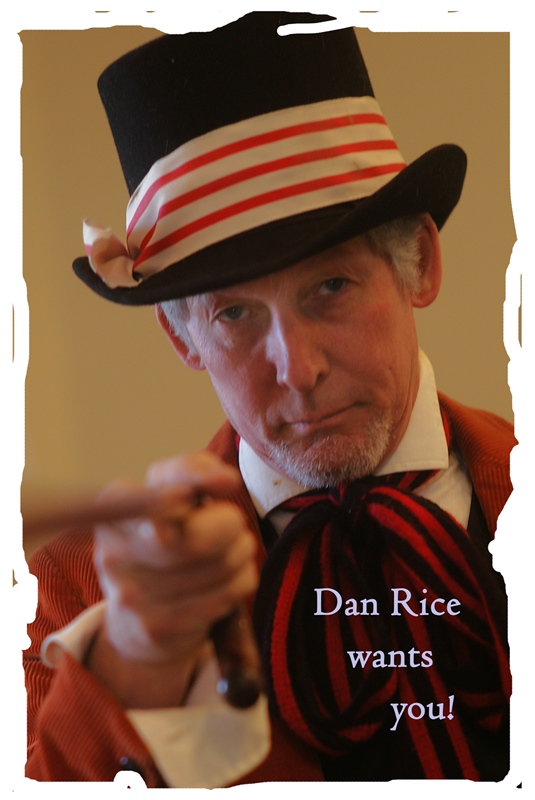
Pre-production still: Bill as ringmaster Dan Rice in A RESTING PLACE. Photography © H. Scott Heist 12 / Splintercottage.com
I never bought that bill of goods, though there are parts of it that are true. For me, I thought about Shakespeare. Married once and not necessarily unhappily, it seemed his primary goal in life was to get a decent house in the suburbs and be “normal”. Or Magritte, Chagal, Tobey– all artists that married but once. Albert Schweitzer. There’s a fantasy that goes hand in hand with thinking about “being a star,” “famous,” “making lots of money” that is associated with an approach to life and art, the creation of art, that is decadent and retrograde, if not just downright unhealthy.
Right now, this deep into the year, everyone here at Touchstone, I might venture to say, is pretty beat up, working hard to make something beautiful with very little money and never enough time. It can be pushed too far, unhealthy, but it’s not an essential part of the job. At the same time, the creative process is the task of taking an infinite amount of possible work and putting it into a limited amount of time—always a recipe for stress. But no, the show doesn’t necessarily have to go on. The trick is to push it just as hard as you can without hurting yourself or what you feel to be “right” in regards to your responsibilities to yourself and the world—to obey the laws, take care of your health, be a human being in society. The greater the talent, the greater the difficulty for restraining the beast, but that doesn’t mean excuses should be made, as if artists got a free ride.
We’re about to embark on Alison Carey’s A Resting Place, and I’ll be playing the character of Dan Rice. The script still has some work to be done on it, but a big part of his conflict is that he was an artist, a performer, the leader of a big Carnival Show. We’d call it a circus today. And even though the country plunged into the Civil War over states rights to keep slaves, Dan never took sides. The show had to go on. He went South to get money from the folks down there, telling jokes against the North; and he went North to get his money, telling jokes at the expense of the South. Maybe it was the best he could figure out to do at the time, or maybe the money made him turn his head away from his real responsibilities. I don’t know. I probably never will.
Here at Touchstone, being an artist isn’t an excuse to be free from being responsible for ourselves and the consequences of our choices.
From Emma – Musings of an Incurable Shutter Bug
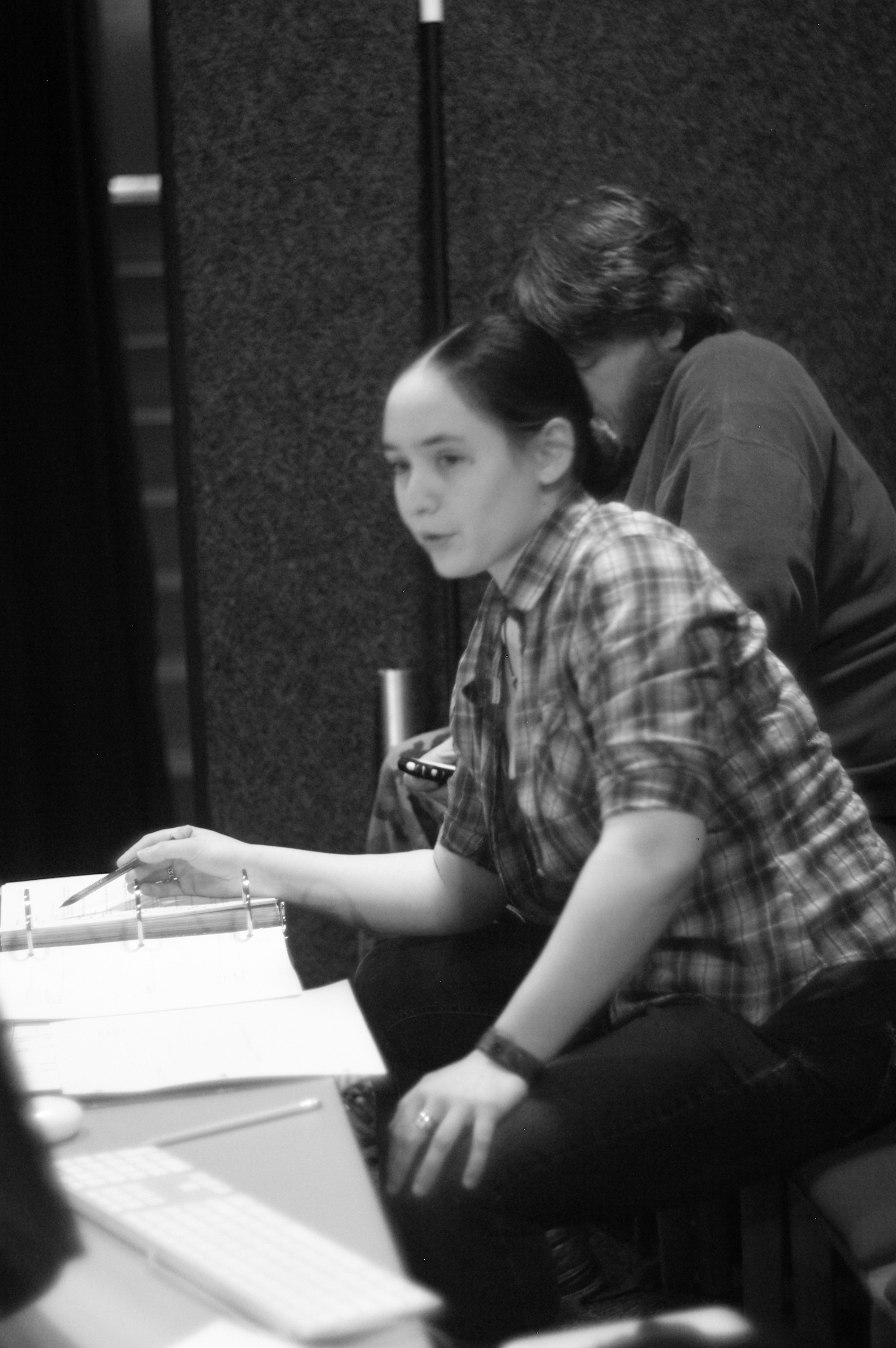
Stage managing and note taking. Photo from The Whitman Piece, copyright H. Scott Heist.
I have this thing about keeping records. Making notes, making lists. Taking photos, audio, and video recording.
Oftentimes, this falls into the category of just doing stage manager things– general operating procedure when I’m stage managing is write down as much as physically possible, because you don’t know what you might end up needing to remember. Between props, costume, set, lights, sound, notes for the cast, notes for the company, notes for the public (not to mention my rabid quote-keeping habit), there’s a lot that feels safer when committed to paper, post-it, or Microsoft Word. I remember better when I write it down.
Because of this tendency, I also find myself as the self-designated note-taker in meetings. When we gather as a Touchstone Ensemble, Cast, or Company. I instinctively write down my own notes, things I need to remember for myself, and keeping notes for the group is a natural extension of that. It’s still in the realm of fairly practical things.
But then I start making excuses to do more of this kind of work– using my laptop to video or audio record sections of a rehearsal or devising session, ostensibly so that we have a record of what we’ve worked on (but actually because selfishly, I just want to hold onto a piece of it for myself), or taking photos for promotional material (again, so that I can protectively store it on my computer), or making other recordings without even having a real use for them in mind.
Photos, especially.

And don't even get me started on my addiction to Photoshop. Photo from Fresh Voices 2010.
I’m so addicted to rehearsal photos. I’m one of those dreadful, obsessive shutter bugs in many aspects of life, but I’m particularly bad about too many photos of rehearsals and shows.

From the stage at my dear old Alma Mater. Photo from Metamorphoses, taken by Sarah Dugan.
My poor hard drive is over-burdened with photos from theatre I’ve done over the last ten years (mostly taken by me, but with scores taken by Scott Heist, Christopher Shorr, Angelica O’Boyle, Thom Hogan, and other friends with artful eyes and nice cameras). More often than not, I can’t bring myself to delete any, even the slightly fuzzy ones. Yes, I’ll say, this photo is kind of blurry and not quite centered, but… I might still want it for something! Eventually!
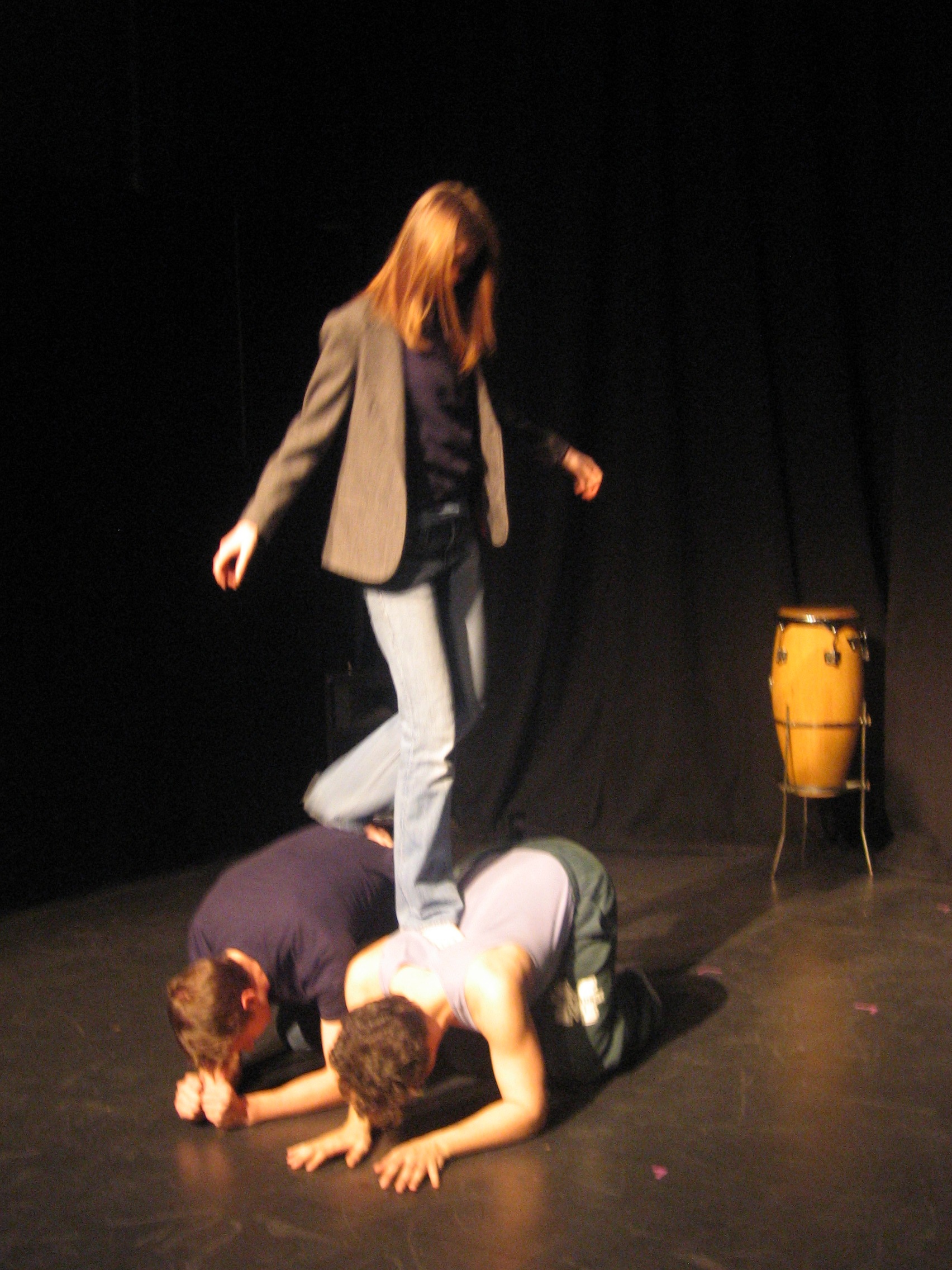
No, wait, the hands don't match, and the stupid drum is in the background, and-- oh, it's probably fine. Photo from Fresh Voices 2009.
I know I’m not alone on this; in the age of Facebook, Twitter, YouTube, Flickr, and dozens of sites like them, think of the millions who love typing up and sharing every detail of what happens in a given day, or hour, or minute. Who doesn’t love the opportunity to take photos and videos, share the view of the world from behind their camera?

And some days, four people come to class wearing matching shirts, and you just need to document that. From Lecoq/movement class 2011.
For me, though, I think that all of this– the writing down rehearsal notes, meeting notes, perverse quotes from backstage, scrambling for my camera as a perfect image emerges in rehearsal– is about trying to capture these fleeting moments of inspiration, eloquence, hilarity, or beauty.
(And in theatre, it really is fleeting– a live show changes in a hundred tiny ways every night, more than a mere photo can ever identify.)
It’s about trying to capture the essence of these moments and finding away to store them, to honor and enjoy and remember for the rest of time, whether through a rectangle of pixels in the “My Pictures” folder or a semi-legible scribble on semi-secure post-it note. Surely, somehow, I tell myself, there must be a means of making these moments– onstage, in the rehearsal room, or anywhere else– last.
(A completely impossible task, naturally, but I can’t make myself stop trying.)
From Katy – Scribbles and Sticky Notes
 This week’s entry comes from the apprentice corner; Miss Katy Fitzpatrick comments on the Fresh Voices rehearsal process and the challenge of creation as an ensemble:
I have a running list of quotes about theatre on my computer. Dashed off on a little digital sticky note, I’ve been jotting them down since this whole Fresh Voices process started. Anything that seems to give a little guidance, or make some sense out of a fundamentally mind-boggling project: you have four people, six weeks, and a couple hundred bucks. Create theatre. (And try not to embarrass yourselves, please.)
- Problem #1: What should Fresh Voices be about? What do we want to say? I thought about drawing from my experiences as a teacher, both overseas and locally and making some comment on education; I thought about building a bonfire onstage and doing a
 very artsy thematic and symbolic exploration of the power of fire. Then I saw this quote: “People don’t come to the theatre to understand; they come to experience.” What do I want people to experience? That’s easy – Kazakhstan, where I lived for two years. Suddenly I found I spoke with an authority and an ease in my writing, as I worked to recreate a country and a culture I know so intimately.
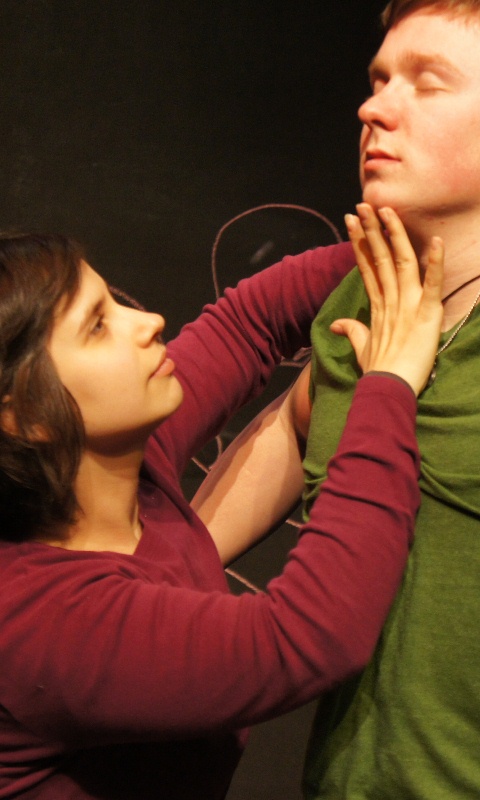
- Problem #2: How can we make Fresh Voices a totally awesome show that everyone likes? Friday afternoons, the four of us apprentices share what we’ve been working on to the 5 ensemble members, who provide feedback and suggest direction. And wow, do they have 5 very distinct aesthetics. The same piece of work has prompted comments as divergent as “This is great, keep going,” to “This is puerile and disappointing.” In rehearsals, I
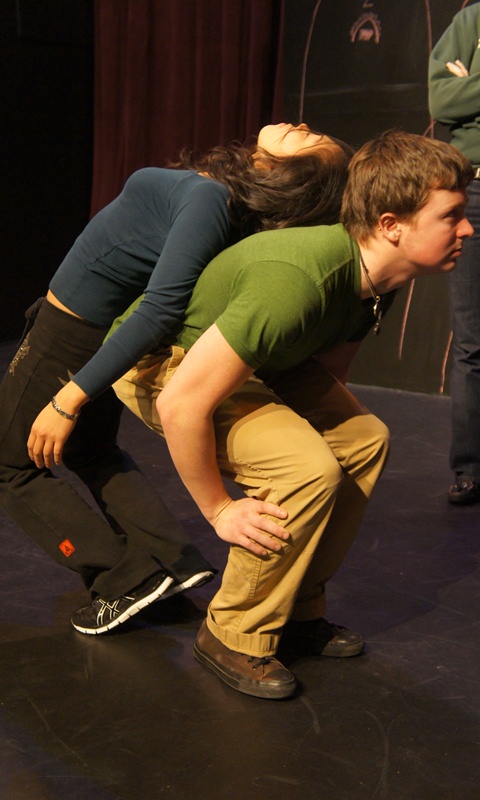
 continually repudiated ideas on the grounds that “So-and-so won’t like it.” After a week of this, fellow apprentice Rob White put down his foot and declared, “If we like our show, the audience will like our show.” From your lips to my sticky note, Rob.
- Problem #3: How do we keep our stress low and spirits high? Let’s face it, stress in creative endeavors is always rooted in fear of inadequacy. What if our show is terrible? What if everybody is disappointed? What if we humiliate ourselves? Which brings me to good old Stanislavsky: “Love the art in yourself, not yourself in the art.” We’ve all got it in us to be creators, but that fragile instinct flees in the face of self-doubt. Speak kindly to yourself. A little faith goes a long way.
From Cathleen – Nature, Embodied
Years ago, my first movement theatre instructor, George, taught me about “embodiment.” In one favorite exercise, we would walk briskly around the theatrical studio, trying to avoid bumping into each other, at the same time focusing on our breath, and keeping an eye on the group being evenly dispersed around the floor space. “Banana!” he would shout, and we would immediately heave our bodies into a gesture. “Keep breathing,” he goaded us further, “And don’t stop…keep moving!”
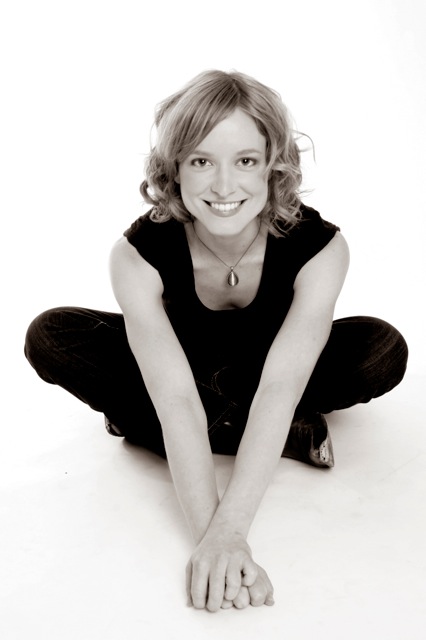
Ensemble Member Cathleen O'Malley, perhaps embodying her frog form
My classmate is baffled, arms vertical, hip jutting out. “But bananas don’t mov…”
“Don’t just LOOK like a banana! BE a banana! Be banana-ey! Don’t think about it–just follow the body! Now—electric fence!”
I force a shiver up through my body, my fingers splay and spike out in all directions. A shriek of laughter escapes me, high pitched. Twitching and jabbing out in all directions, I work to release my thinking mind and, rather, follow my impulses, born from associations. I am starting to get into it, catching the spirit, so to speak.
“Champagne!” Effervescent, I send a trill of breath and sound, up through my throat, resonating high in my forehead, tones cascading and slipping along the scales. My fingers are bubbles and I spin, off-balance for a moment on tiptoe, then catching myself in a soft landing of my heels before spinning off in the opposite direction, my head and neck loose as if connecting by a string.
Not the shape of the material, George reminded us, but the being of it. Champagne-ness.
Little did I know at the time, my teacher was introducing (via a high adrenaline version) a tool that would be at the source of my work and training as an actor for years to come.
“Imagine,” George would propose, “there are, say, 800 million things in the world. For as many things there are in the world, there are that many ways to laugh, or to move.” And as we awoke to the world around us, we could see it. People with material characteristics, just burbling under the surface.
Objects in nature—including animals and materials, like oil, paper or clay—have concrete attributes that lend to their essential nature, or—to speak in terms of theatre—character. We see this in life—and our language reflects this propensity to metaphor.
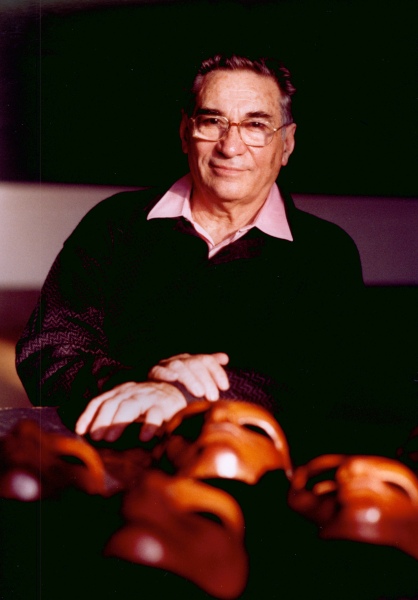
The brilliant physical theatre pioneer, Jacques Lecoq
An unruly child may act piggish, or squirrely; celebs are hounded by the press; our personalities can be mercurial, our humor, dry, our movements, fluid. Leaving a party, we may reflect that the group was warm, or that the conversation flowed.
One of Touchstone’s earliest influences—the French theatre master, Jacques Lecoq (1921-1999), who visited Touchstone in the early 90s—was one of the pioneers in the physically-based theatre movement in Western Europe, whose influence has extended into colleges, university, stages and studios across the United States. He taught his students to observe qualities of materials, animals and the elements of nature to inspire nuanced and imaginative characters onstage.
This work lends a richness to a performance that has applications in a wide variety of theatrical genres. Famous students of Lecoq include director and designer Julie Taymor (the evocative puppetry of The Lion King) and acclaimed British film and stage actor Geoffrey Rush.
The “embodied” approach to creating dynamic, engaging theatre was fundamental to Touchstone’s early theatrical work. And now, some designers and architects are getting attention for working from metaphor in a similar fashion, creating dynamic public spaces inspired by natural structures–particularly trees.
These digital days, one can access virtually unlimited content and social connection without any physical contact with people or the natural world. What was lost when we humans began taming the wilderness, or our own wildness for that matter? Neuroscience is teaching us that our minds are less rational than we once thought and that our experience of world around us is more associative in nature.
As artists, let us take up the task of creating work that not only stimulates the intellect, but works upon the audience–richly imaginative and metaphorically-inclined minds that are inextricable from the bodies they inhabit.
From Lisa – Still Fresh, Over a Decade Later

The 2011-2012 Touchstone Apprentices
Every season for over a decade, Touchstone has hosted a class of two to six apprentices. They come from as far away as Paris, France, and as close as our own backyard of Bethlehem and the Greater Lehigh Valley. Primarily, the apprentices come directly out of an undergraduate theater arts program; some come from our friends at the Dell’Arte International School of Physical Theatre in California, and a few are mid-career professionals who have come to the theatre looking to get back to training or to approach theatre creation from a non-traditional rather than scripted method. Some are drawn to the actor-created original plays or devising work that Touchstone offers, others the classes in physical theatre, and some for the arts-in-education or community-based experiences the apprentice program supports.
However they make it here and whatever drew them in initially, they all embark on an original, actor-created show called… Fresh Voices!
Fresh Voices gets posited into the minds of each potential apprentice at auditions. The idea of creating and performing their own piece of theatre, as well as collaborating with their fellow apprentices on an ensemble piece, is a key element of the apprenticeship and is met with great excitement. Many actors get few opportunities to create their own work; most undergraduate programs focus on classic and contemporary scripts, allowing for vast experiences in performance of other playwrights’ words but not their own. Touchstone offers this unique opportunity, and while for some the prospect may be a mix of thrilling and terrifying, it is a tremendous experience well worth the blood, sweat, and occasional tears that comes with the original creation process.
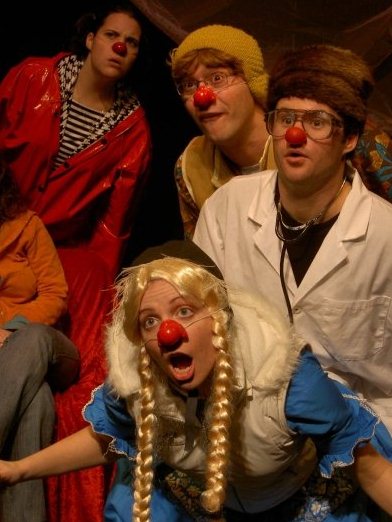
A gaggle of clowns in FRESH VOICES, from the '07-'08 Touchstone Apprentices
Several months after auditions, the apprenticeship is well under way, and the Touchstone Company is getting to know each of them more and more. By the time Christmas City Follies rolls around, we can probably speculate as to what kind of piece each may tackle – in the past some have been comedic, others tragic, using a variety of techniques and styles: mask, trapeze, musical, solo storytelling, or anything in between. One piece in my first year at Touchstone involved a live chicken!
This year’s apprentices are a wonderfully assorted group – one from Pennsylvania, one originally from Maryland, one from California, and one from Washington; two coming from a performance background, one from playwriting and one from a community-based approach. Together, they’ve been hard at work since early October creating an evening of their new work, recently deciding on the subtitle “Demons and Delights”.
This Friday marks the first time this year’s apprentice class will share their works-in-progress; every Friday after, they will continue to share their developing pieces with the Touchstone Ensemble, receiving feedback and guidance as they prepare to unveil them the last weekend of February.
But until Friday, I’ll have to be content with hearing the excited conversations as the four apprentices, Rob, Nicole, Meggan and Katy, go in and out of rehearsals… or sneak another peek at the large sheet of paper that hangs prominently in between their desks and is filled with the ideas from last week’s brainstorming session.
For more on Touchstone Theatre’s Apprenticeship Program, click here.

Rob and Meggan bask in the wall-o-ideas.
From Jp – A Much Deserved Break
What an artistically fruitful autumn it has been for all of us at Touchstone!
We started the season with our first ever horror themed evening of one acts, Into The Dark, which highlighted the vision and playwriting of individual Ensemble Members. This was a new form and topic for the Ensemble to tackle, but the Touchstone Ensemble adapted, and the show was a great success.

The finale of Touchstone's all-new eerie production, INTO THE DARK
We then had the privilege of presenting Sean Christopher Lewis’s one man show Killadelphia as part of a grant received from the NEA. Killadelphia explored violence in the city of brotherly love and questioned redemption. Sean’s storytelling and character playing ability made for an insightful and thought provoking series of performances. While in town, we were also able to help present Sean at Broughal Middle School and Moravian College, where along with the show, Sean held workshops for the students.

Sean Christopher Lewis in his acclaimed one-man show, KILLADELPHIA
Last but not least, wrapping up our fall season was Christmas City Follies XII. I’ve been directing Follies for the last four years, was the Musical Director for the three years prior to that, and I still haven’t grown bored with building this show. I truly look forward to directing this show and would love to find other outlets for the Ensemble to create similarly styled projects.
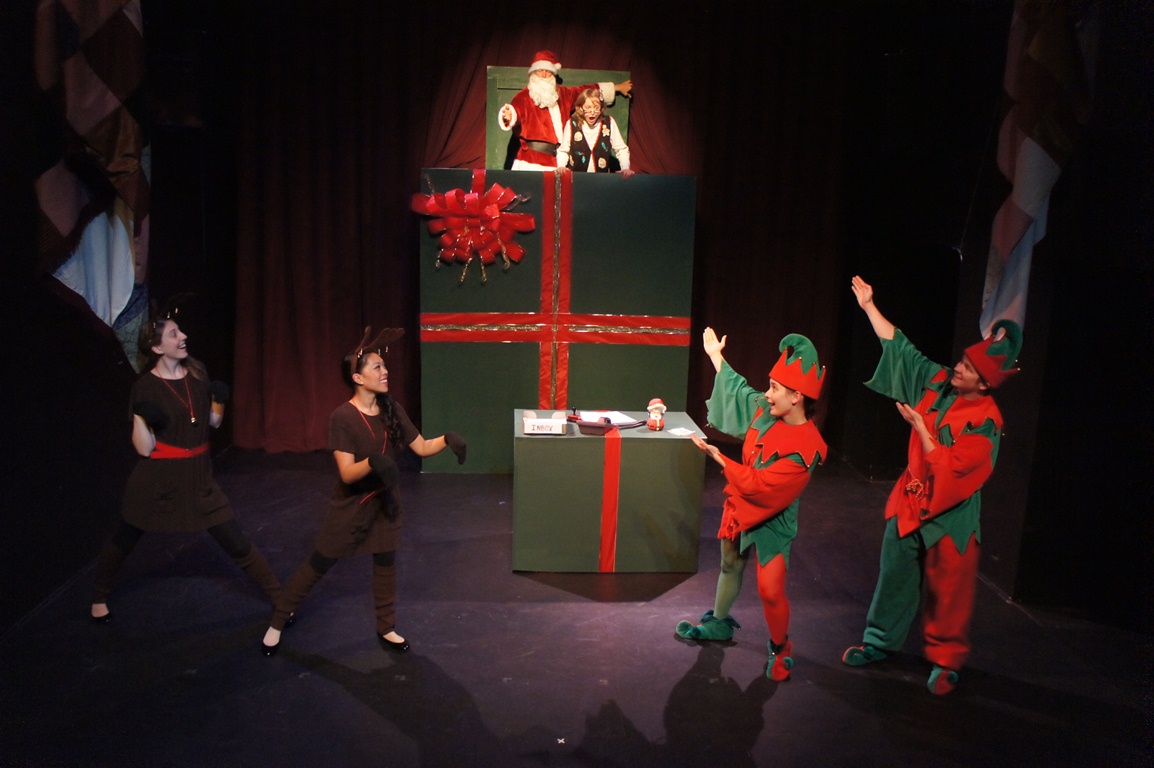
The music, mischief, and merriment of CHRISTMAS CITY FOLLIES XII
So, we’ve been busy, and now we rest.
Thank you all for your patronage and support of Touchstone. We will back working hard come January, but till then, may you all have a safe and restful holiday season.
Looking forward to the coming season? Don’t wait! Check out the blog for Touchstone’s Civil War/Cemetery Project. Follow us on Facebook and Twitter, and check out our photos on Flickr!

Two lovelorn clowns
The hardest thing for me about doing anything is the challenge of working with other people, and nothing is more demanding on one’s interpersonal skills than creating theatre–creating anything that you actually care about and that someone else has some degree of control or influence over.
Painters have it easy. It’s them alone with the object. Writers, too. They have to deal with audiences’ misunderstandings or criticisms of their work, but the work itself is theirs and theirs alone. In the performing arts, that is very much not the case, and in Ensemble Theatre, where everyone is a partner to one degree or another, you have to deal not only with criticism, misunderstanding, but just plain old differences of opinion and taste.
But most of the time, that’s where the fun comes from too.
Emma keeps track of some of the more humorous reactions to this stress. Here are a few of the easier ones to understand if you weren’t there in the moment:
We try to be open to all ideas at first, but it’s the plethora of possibilities, and deciding which to choose, that is at the heart of the creative problem–
- BILL: “Okay, I have another idea… that combines with shadow…!” JP: “Bill, remember how I said there were no bad ideas?”
- MARY: [Proposing a scene] “It sounds stupid, now that I’m saying it…” EMMA: “We did dinosaurs [last year] – we can sell anything.”
- BILL: “I spent two hours going, ‘Oh my god…the fire of existence is like…”
- MARY: “I solve my creative problems by shopping.”
And invariably along the way we’ve got to deal with our sexuality–
- ROB: “I think the phrase ‘throaty moan’ is the dirtiest two words I’ve ever heard in the English language!”
- EMMA: “Would you light my candle?” KATY: “I don’t want to light your candle!”
- MARY: “It’s true—size really doesn’t matter.” ROB: “It’s how much applause you get.”
- BILL: “Cathleen, would you be willing to create a clown? Based on your failure as a lover?” CATHLEEN: “…Sure… I mean, I’d have to dig deep…”
Our insecurities–
- NICOLE: [as PJ Sister] Write? We just learned to talk this year!”
- BILL: “It’s kind of stupid. Or pathetic. It’s like something I would do.”
- MARY: “I’m really good at looking silly.”
- KATY: “[as Cathleen goes over Christmas Mouse]…I’m feeling really bad for the mice I caught.”
Our political inclinations–
- JP: “[weighing options for PJ Sisters] Either one promotes my libertarian values.”
- BILL: “I left Saddam Hussein on the cart—god rest his soul—and he was upstaging me for the whole scene!”
The stress of the work–
- BILL: “Does anyone have a remedy for getting [‘Don’t Stop Believing’] out of my head?”
- JP: “Christmas City Follies XII – guaranteed to make you sick to your stomach.”
- LISA: “[having to explain a costume choice] Because she’s green… and you’re green… and it’s not easy being green.”
- JP: “If Bill screws that up again, you grab the ukulele and smash him over the head with it.” NICOLE: “Yes!”
- LISA: “[enforcing the “must hang up costumes” rule] I know who hangs up and who doesn’t. I’m like Santa Claus.”
And on and on. The work creates heat, and without humor and a self-deprecating good will, there’s no way to dissipate it. It requires respect for your co-workers and all their efforts no matter how wonderful or laughable. Eventually, time does its thing, the rehearsal room is silent again, and what is left is, I believe, more than a memory. It is an indestructible knowledge of life itself, ever evolving into something more, something else.
From Emma – The Crunch Crunchiest Time of the Year

The view from Crunch Time '09
It’s the Tuesday after Thanksgiving, which means that we’re waist-deep into crunch time!
I like to think that Follies crunch time is unique for a number of reasons. For starters, the week before opening any theatrical show is typically a stressful time (affectionately called “Hell Week” by some). Costumes are being fitted; technical cues being programmed; and the last pieces of set are being bought, borrowed, or built. There are plenty of details to be tweaked during production week, and that’s a crunch at almost any theatre in the world.
On top of that, Follies is an original play every year, which means that not only are the cast actors– they’re also writers, directors, and collaborators, all working together to make the show into something artistically cohesive. It’s new material, material that we in the cast and crew all love, but of course we aren’t yet sure that the audience (and you can join that audience, speaking of, by clicking HERE and buying your tickets) will feel the same. There’s a lot of guessing and second-guessing as we do last-minute tweaks. Even the nature of the scenes– many of them built out of improv games and group writing exercises– is to change, adapt to the big picture of the show that only comes together at the end.
And it’s made all the crunchier because at Touchstone, of course, none of us is just doing one job. The Artistic Director and director of the show is also editing sound cues, assembling set elements, designing the program. The Managing Director, in between meetings and emails, is buying and returning props, hot-gluing and stitching costumes, viewing and deciding. The cast, when they’re not onstage, are painting giant presents, assembling matching shoes, climbing ladders to adjust lights, or even just decorating the theatre to make things look a little more Christmas-y.
I have a love-hate relationship with crunch time.

Setting up for Crunch Time '08
There’s a very palpable mania about this week. On the one hand, it’s stressful (as you might have guessed, with the crunching and all) – there will be a lot of fretting and fingernail-biting and nerves fraying, because we want to make this a successful Follies. We want to be new and innovative but traditional and lovable. We want to remember our choreography, get a laugh from the audience, keep the show moving and engaging, be consistent but not predictable, and it takes a lot of stress and strain to make that happen
But it does happen. It’s impossible, and it’s wonderful.
So, that’s where I am: contentedly frazzled in crunch time. Two nights from now, we open. We can’t wait to show you what this year’s crunch has yielded.

 Touchstone Backstage